

Download the free kindergarten lesson plan template in Word format or PDF format. Use Word to change the layout. Use the PDF for printing; check whether your PDF reader supports filling any available form fields.
How to write a useful kindergarten lesson plan
- Choose one observable goal: for example, “Children will count a group of up to five objects, touching each object once.”
- Prepare materials: list what you need and set out the smallest useful amount.
- Model the task: show one example and explain your thinking.
- Plan time to explore: let children handle objects, talk, draw, or try the task themselves.
- Include support and an extension: use fewer objects for support and a larger quantity for an extra challenge.
- Check learning: note what the child actually did and what you will try next.
Completed example: counting autumn leaves
Suggested group: a small kindergarten group. Time: about 15–20 minutes, adjusted to the children. Goal: count up to five paper leaves and say the total.
Materials: leaf templates, crayons, large precut paper leaves, and number cards 1–5. An adult can prepare the cutouts in advance.
- Introduce, 2 minutes: show three leaves and ask how children could find the total.
- Model, 3 minutes: move each leaf once while counting. Say, “There are three leaves altogether.”
- Explore, 7–10 minutes: children choose a card and make a matching group of leaves. A partner checks by counting.
- Share, 3–5 minutes: invite children to show a group and explain how they checked it.
Support: use 1–3 leaves, model again, or let the child point while you count. Extend: compare two groups or find two ways to make five. Observe: record whether each child counted every object once and could tell you the total. Avoid treating speed as the goal.
Home version: count a few toy cars, large blocks, or paper leaves with one child. Try our activities at home or math games for another lesson idea.
The Role of Teachers in Kindergarten
Kindergarten builds a foundation for a child’s education later on in life. Kindergarten teachers have a vital role in early childhood development by fostering basic intellectual and social foundations. To lay these foundations, kindergarten teachers may implement several teaching methods that prepare students to express themselves while learning. Successfully teaching in kindergarten is about finding the right balance between fun and learning. The following tasks help find this balance:
- Planning themes
- Organizing materials
- Implementing age-appropriate approaches
- Exploring practical and hands-on activities
- Creating engaging work stations
- Lining up a number of organized resources
Working with young children is always challenging. There is constant activity, interruptions, and various challenges. Teaching Kindergarten is not an easy task as the teachers have to:
- help students with academic learning
- keep them engaged
- face many other challenges like helping students make the transition to kindergarten
- handle the students’ outbursts and tantrums
Kindergarten Lesson Plan
You can find lesson plans for Kindergarten teachers below.
Important Tips for Kindergarten Lesson Planning
Keeping organized is very important when teaching. Having a theme-based plan to follow Kindergarten lesson plans is one way to make sure your teaching stays on track. Here are some tips to organize your kindergarten lesson plans:
- Set weekly or monthly themes as they are a great way to cover lots of different learning activities.
- When educators work in pairs or groups, they can leverage the talents of those in the room and create classroom activities that address multiple styles of learning.
- Provide hands-on learning experiences to understand the material taught.
- Make your lesson plan time-bound and divide lessons and activities into sections.
Teaching Methods in Kindergarten:
Kindergarten methods of teaching can include group learning or small group instruction in which children divide into groups of two or more to work together on a project. Pair work and small group learning is critically important for promoting a child’s social skills as it promotes inclusive education and enhances collaborative skills among the students. When children work collaboratively with peers, they learn how to communicate in ways that create harmonious social relationships.
To sum up, the goal of each kindergarten lesson plan is to prepare children well for the more formal learning that takes place in grade school.
Kindergarten Lesson Plan Template
Use the Word file to adapt the template to your classroom or homeschool routine. The PDF version is available for printing. Preview pages and download links are below.
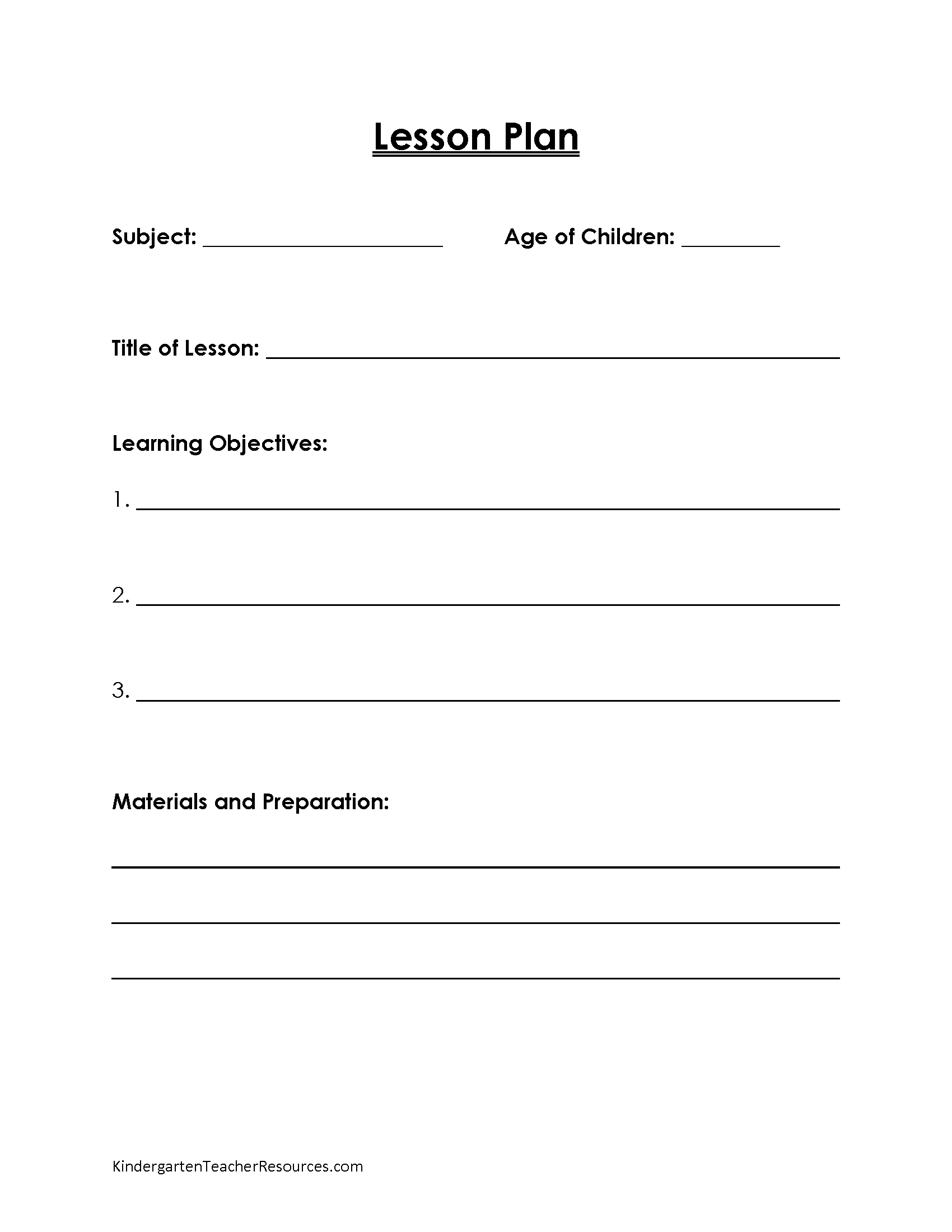


Use Word to change the lesson plan layout or type your plan. Use the PDF to print a copy and write your plan by hand. PDF form entry depends on the file and the reader you use.